
AI systems lack consistency because they generate responses probabilistically rather than deterministically. This means the same input can produce different outputs depending on randomness, context, and how the model processes the request.
Unlike traditional software, AI does not follow fixed rules, it predicts likely responses, which can vary each time.
What inconsistency means in AI
Inconsistent behavior occurs when:
- The same question produces different answers
- Outputs vary in tone, accuracy, or detail
- Results change across sessions or users
This makes AI systems harder to trust and control.
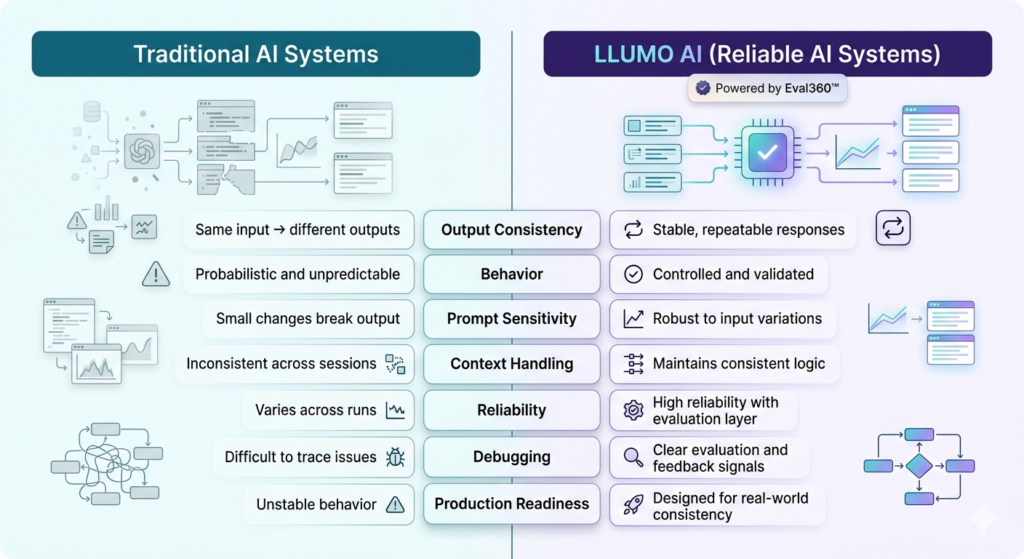
Key reasons AI systems lack consistency
- Non-deterministic generation
Models use sampling methods (like temperature), which introduce randomness in outputs - Prompt sensitivity
Small changes in wording can significantly alter the response - Context dependency
Previous interactions influence how the model responds - Model variability
Different configurations or updates can change behavior - Ambiguity in inputs
If a query is unclear, the model may interpret it differently each time
Why this matters
Lack of consistency leads to:
- Reduced trust in AI systems
- Unpredictable user experience
- Difficulty in debugging and testing
- Challenges in production deployment
For businesses, inconsistent outputs can directly impact reliability and decision-making.
What this means for AI reliability ?
Consistency is not built-in, it must be engineered.
To improve consistency, systems need:
- Controlled generation settings
- Standardized prompts
- Validation layers
- Continuous evaluation
Key takeaway
AI systems are not inherently stable.
Consistency requires system-level design, not just better models.
Real-world example
A user asks the same customer support question twice.
The AI:
- Gives two different answers
- Uses different reasoning
- Provides inconsistent recommendations
This reduces confidence in the system, even if both answers seem reasonable.
FAQs
Why does the same AI give different answers?
Because it generates responses probabilistically, not through fixed rules.
Can AI systems be made fully consistent?
Not completely, but consistency can be significantly improved with constraints and evaluation systems.
Does temperature affect consistency?
Yes. Higher temperature increases randomness, while lower temperature improves consistency.
Why is consistency important in AI?
It ensures predictable behavior, builds trust, and improves reliability in production systems.
CTA
Build consistent and reliable AI systems with LLUMO AI
Explore the AI Reliability Whitepaper